
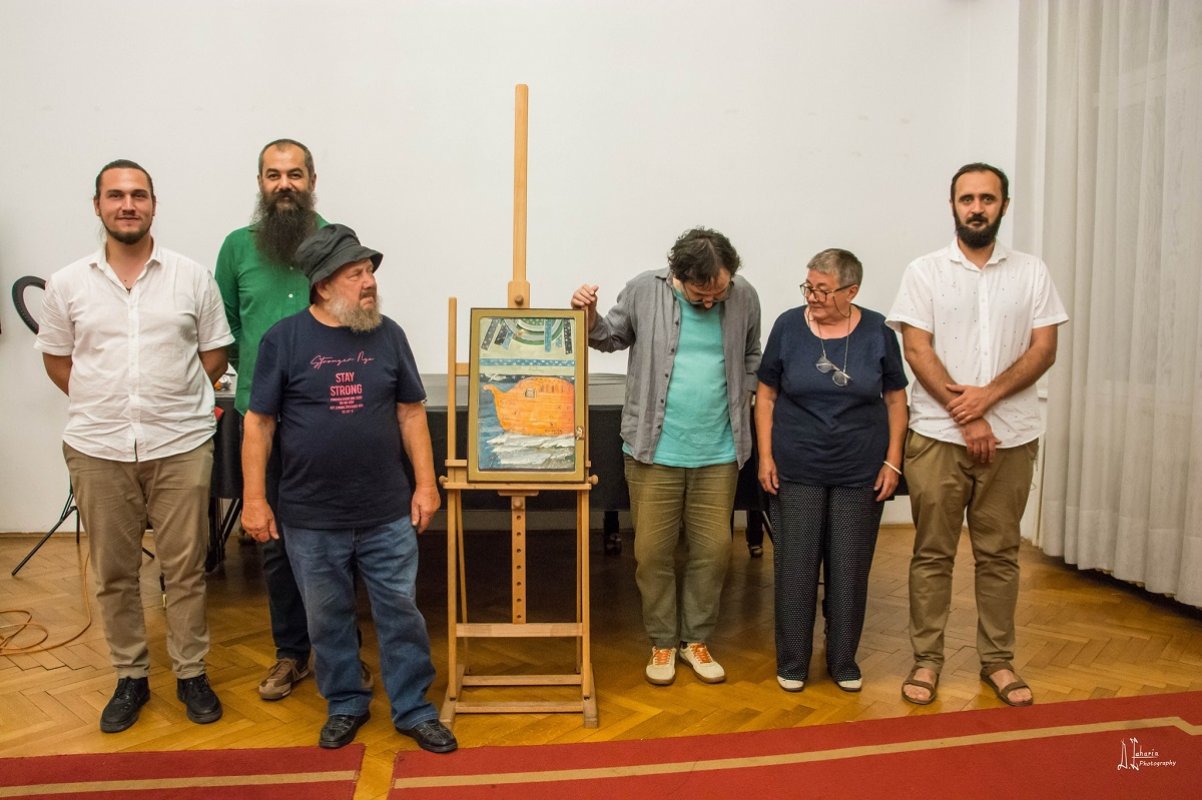
Interview by Biljana Đogić and Miona Kovačević / Photo: Marko Rupena, Nemanja Boškov, Dumitru Zaharia
One of the most prominent Romanian icon painters of the middle generation, Mihai Coman, has for years held a distinguished place on Europe’s contemporary sacred art scene. He is a professor at the Faculty of Orthodox Theology at the University of Bucharest, where he teaches drawing, color, and composition within the framework of the Byzantine visual system. He maintains close, multilayered, and continuous ties with the Serbian art scene — as an educator, collaborator, and artist who frequently exhibits in Belgrade.
Our conversation with him was conducted as part of the project “Serbian Culture in the Focus of UNESCO,” which approaches contemporary cultural heritage as a living and dynamic process.
Born in Romania in 1979, he completed his academic studies in conservation and restoration of artworks at the National University of Arts in Bucharest. He also earned a master’s degree in pastoral and liturgical life at the same theological institution. He received his PhD in Byzantine iconography from the Faculty of Theology of the National and Kapodistrian University of Athens, where he was for a time a student of Professor Giorgos Kordis.
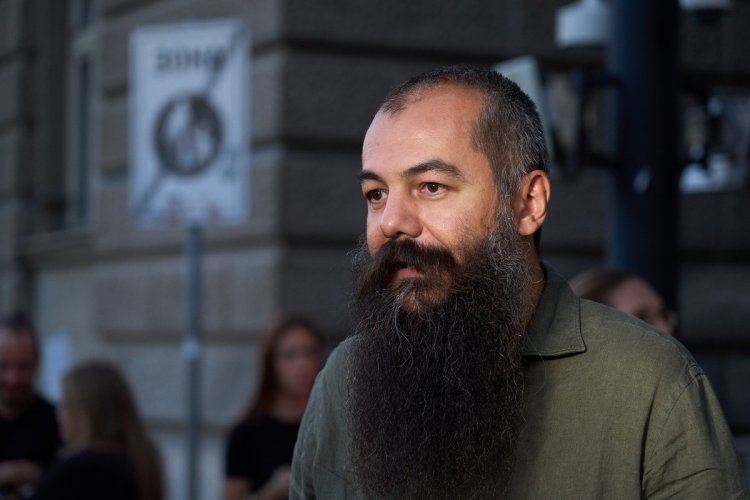
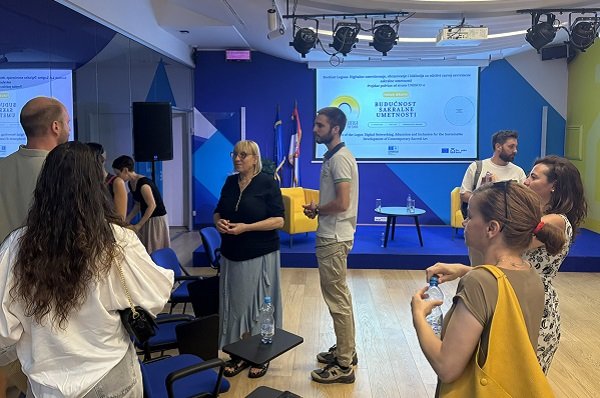
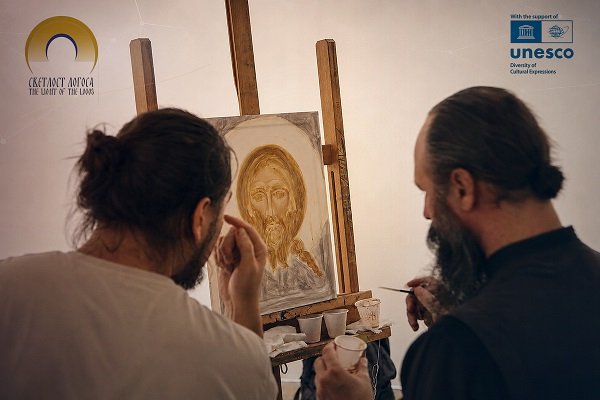
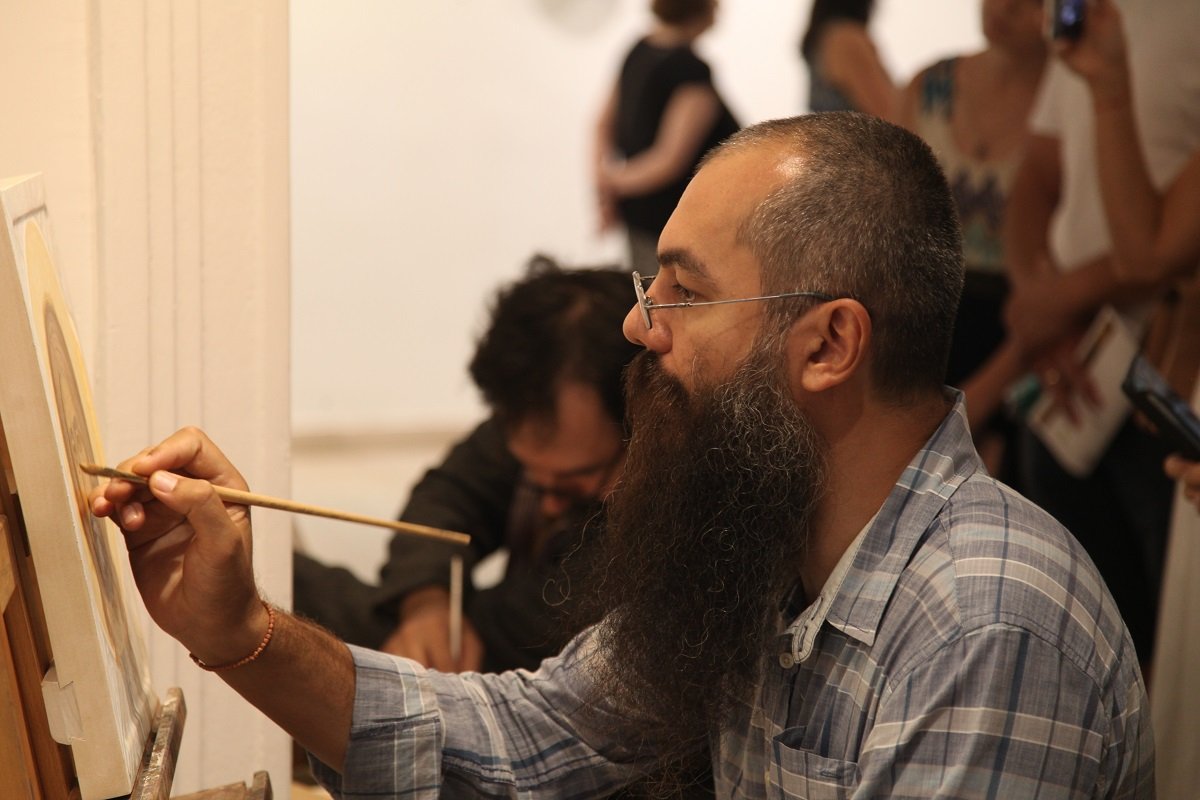
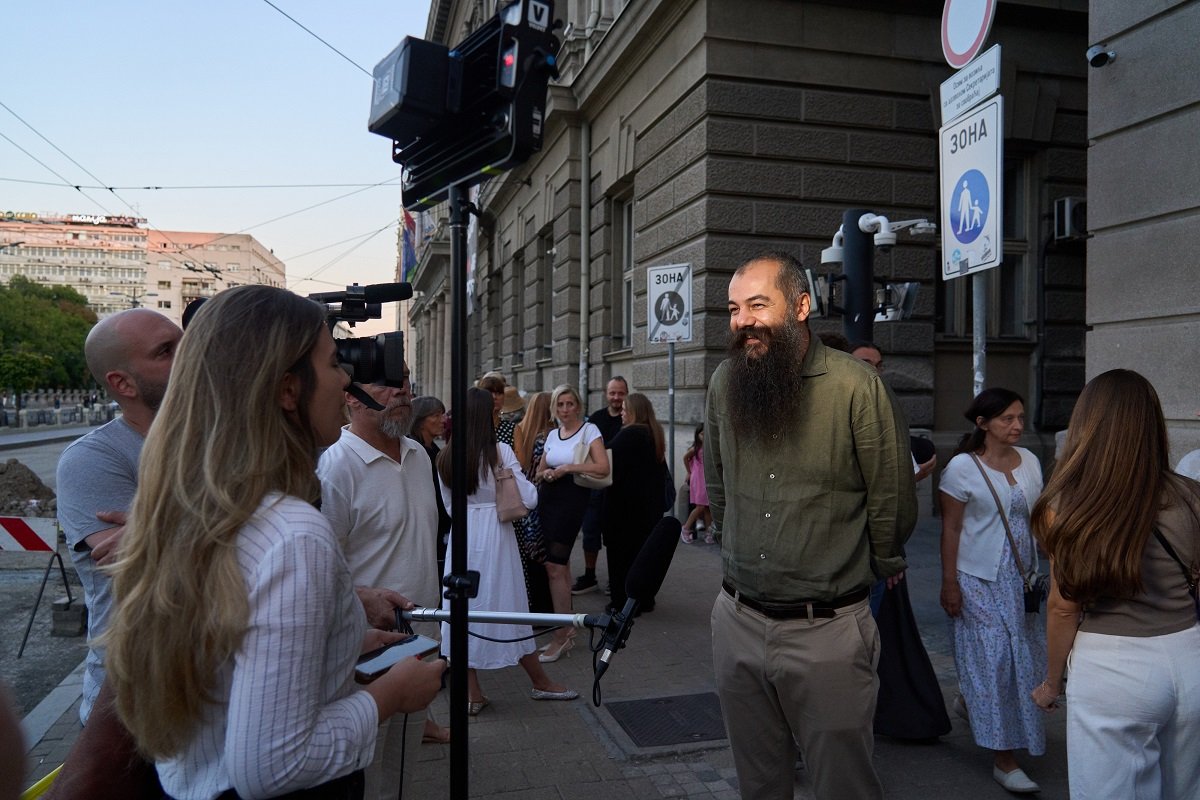
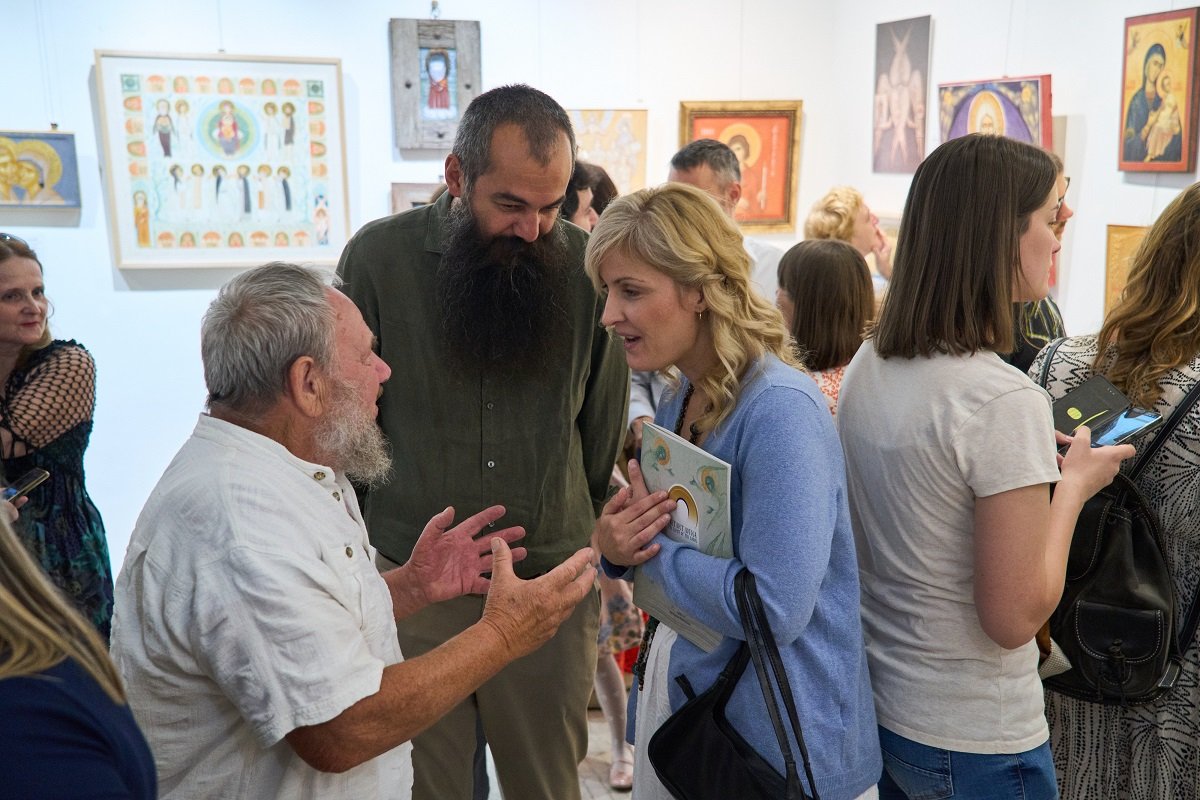
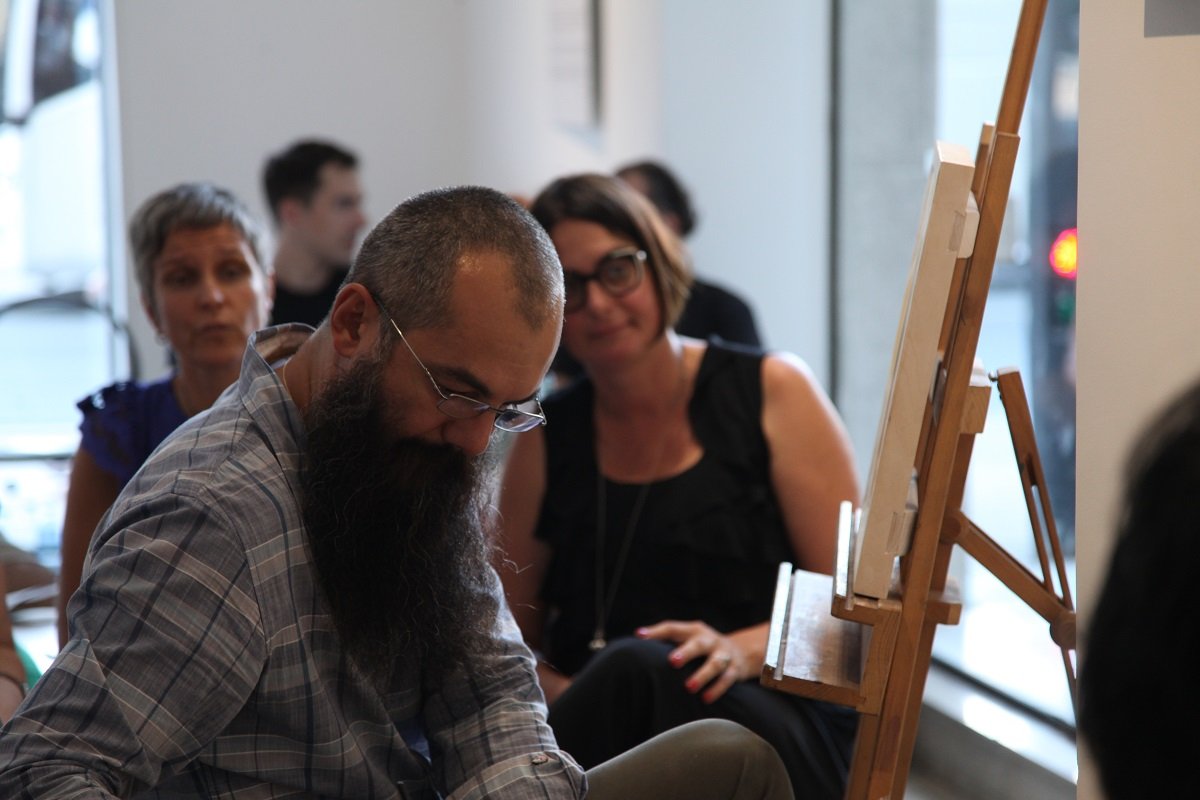
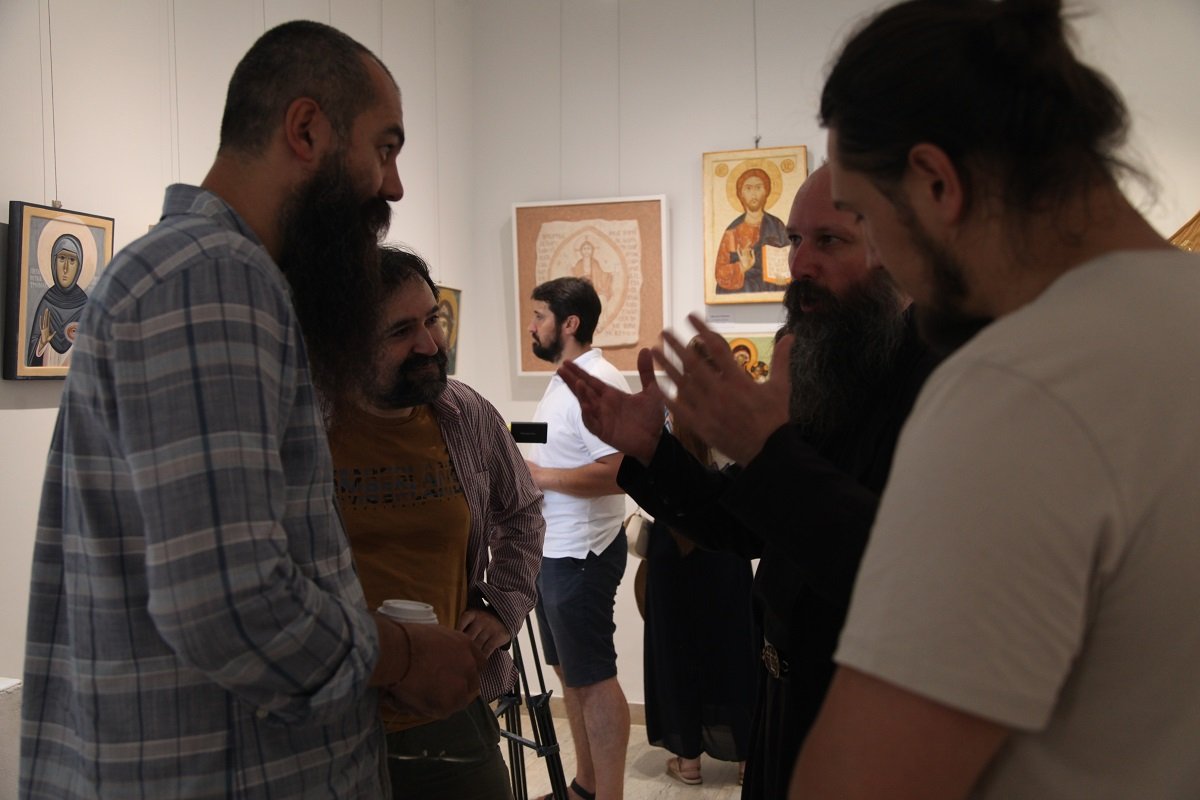
Mihai Coman in Belgrade at the "The Light of the Logos" exhibition, 2025
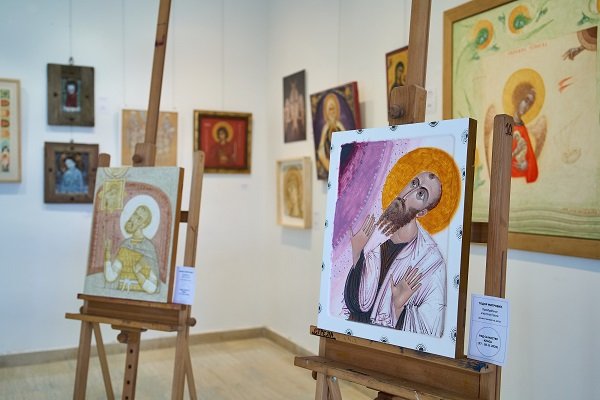
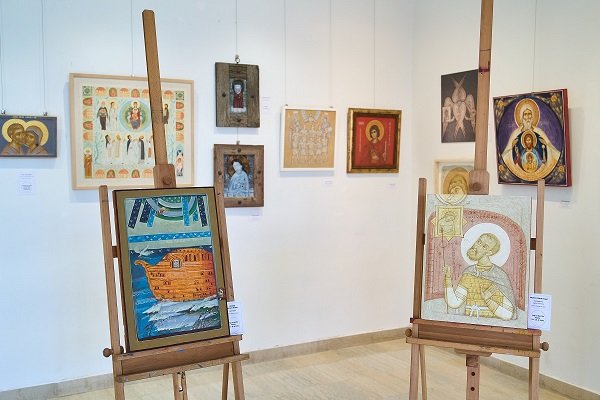
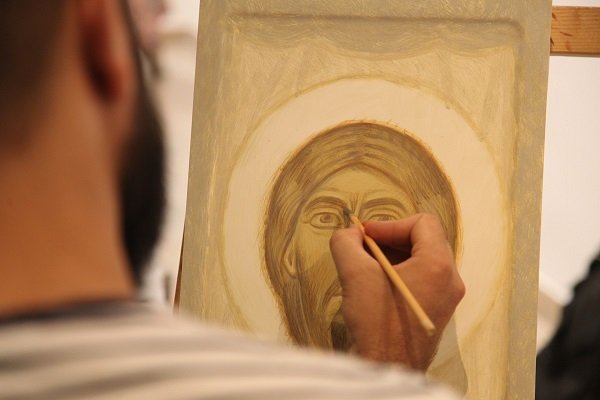
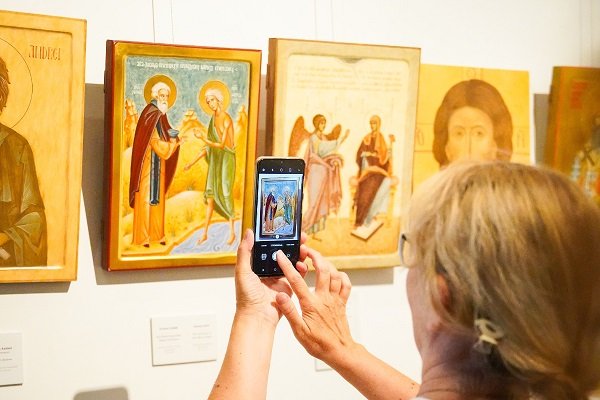
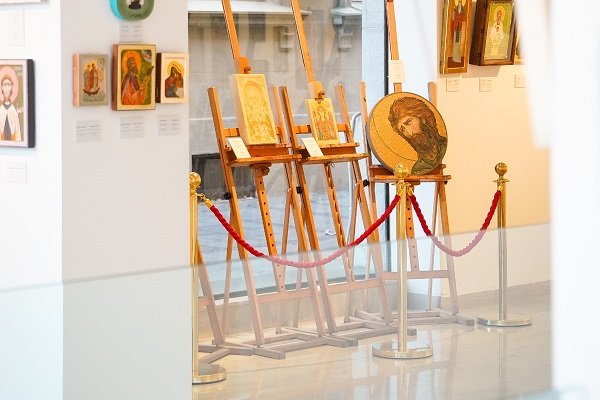
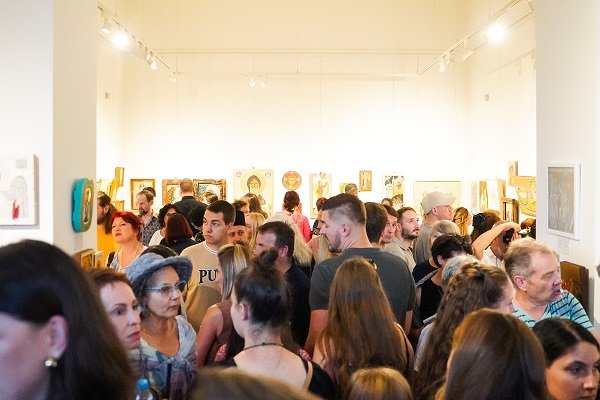
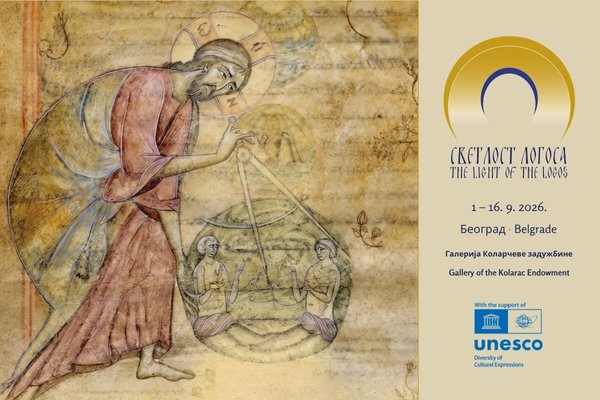
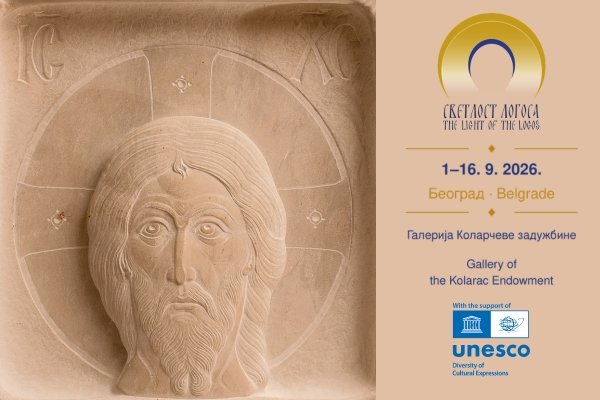
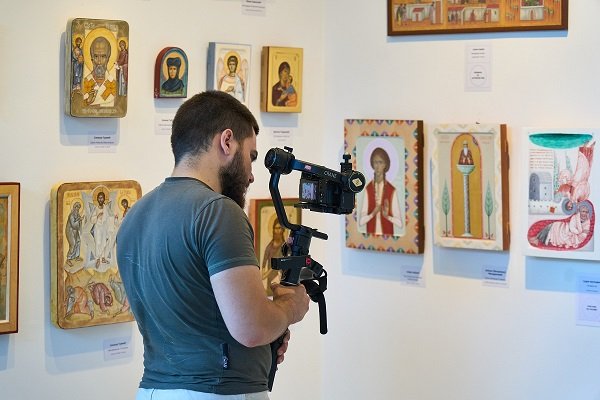
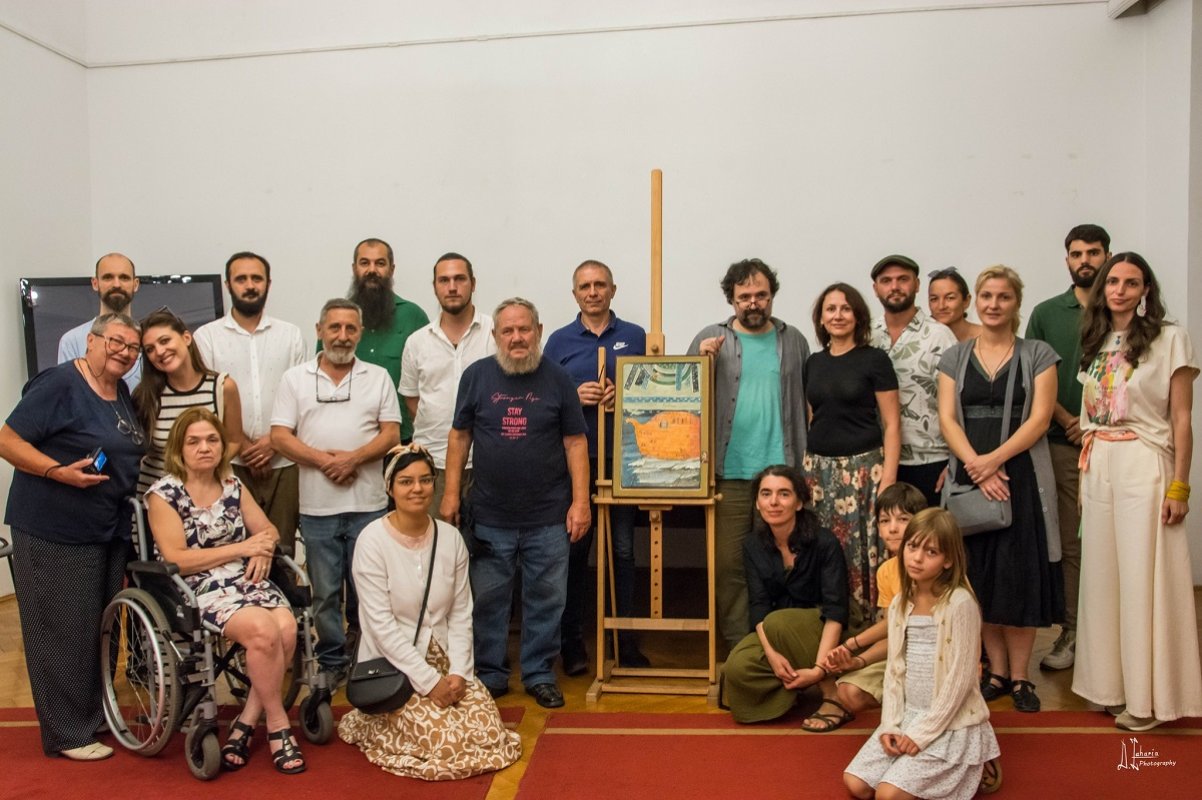
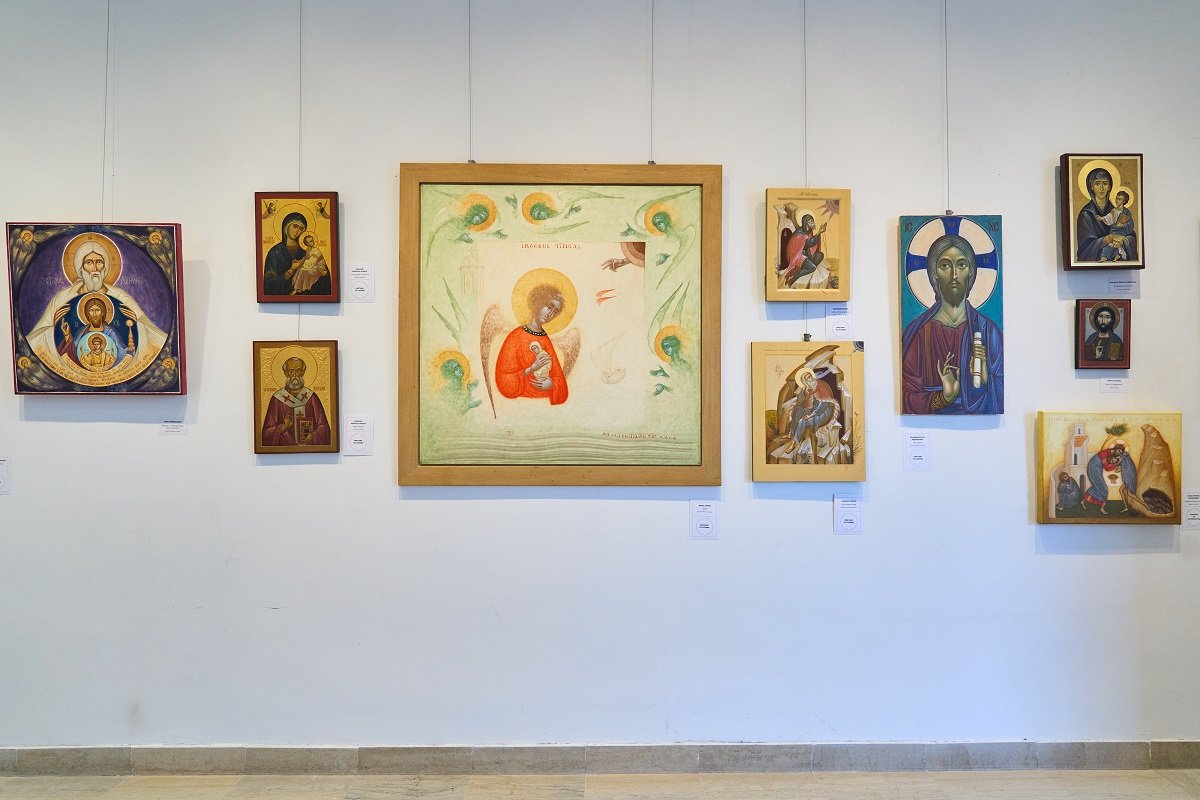
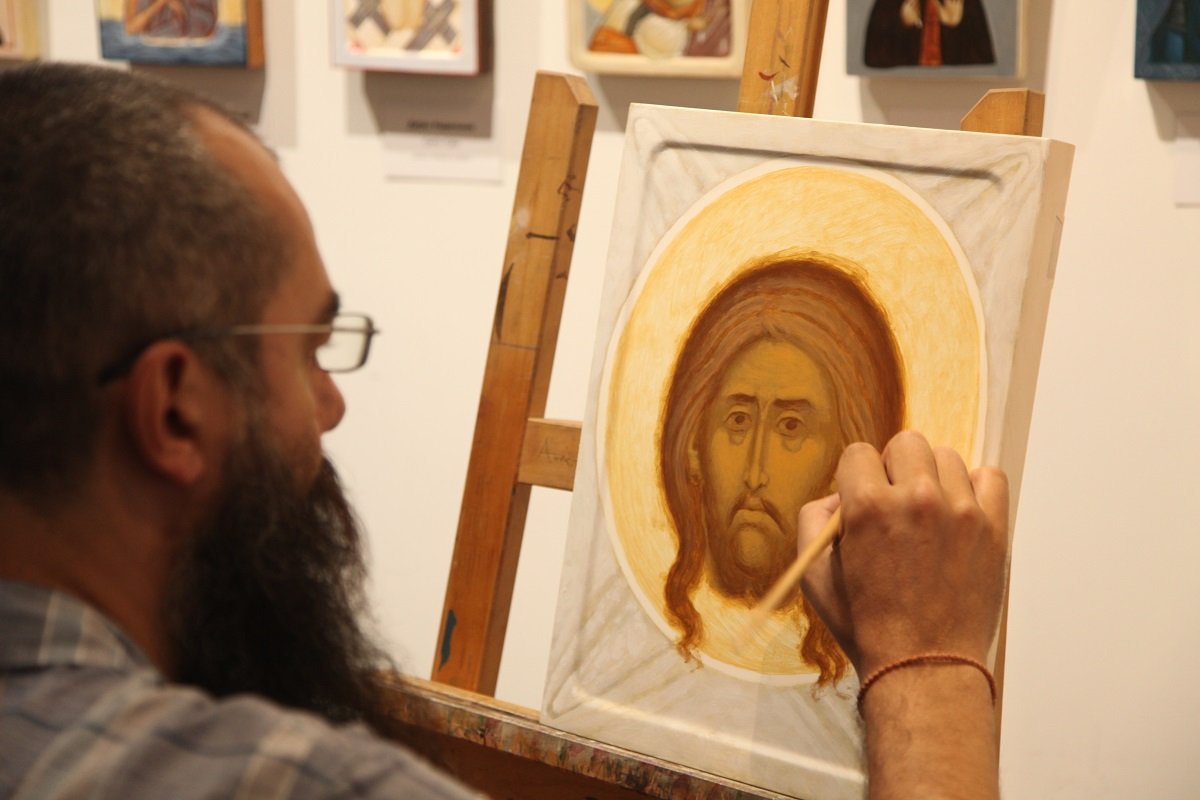
Mihai Coman participated by invitation in the exhibition The Light of the Logos 2025, where he also took part in a two-day masterclass that included live collaborative painting.
Coman’s artistic practice and reflections on icon painting raise important questions about the shared spiritual space of Orthodox culture, the balance between heritage and personal artistic expression, and the icon as a language that transcends borders while remaining deeply rooted in liturgical experience. Our conversation also touched on the relationship between content and style, historical truth and contemporary expression, as well as simplicity and clarity as essential elements of the iconographic language.
His responses contribute to an understanding of the icon and fresco not only as works of art, but as cultural practice and shared memory, in keeping with UNESCO’s contemporary approach to safeguarding and transmitting intangible cultural heritage.
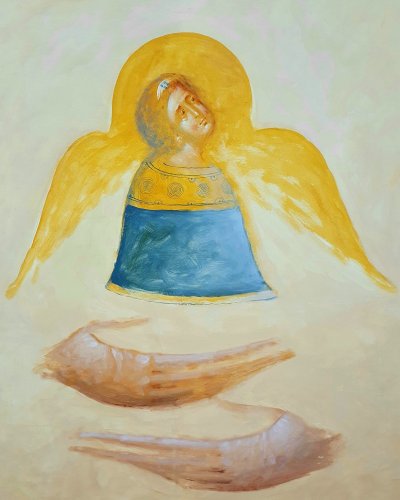
Photo credit: Mihai Coman
What are your impressions of the exhibition The Light of the Logos and the event as a whole?
My participation in the exhibition, as well as my experience of seeing it, brought me immense joy for several reasons. One was, of course, the presence of His Holiness, Serbian Patriarch Porfirije. It was also an honor to take part in such a beautiful exhibition in a city where I have many friends. But most importantly, the exhibition demonstrated the unity of Orthodox culture, which knows no borders, geographical regions, or countries.
Our faith has united us and shown, both to ourselves and to others, that we share a common foundation and a common culture. In fact, we are the same people. We may speak different languages, but in church we speak the same language. The icon is the same for all of us. Through the creation of icons, we understand the same reality. It is our shared language, which is wonderful, because it makes us part of the same community, the universal community of the Church. In the Church, there are no borders.
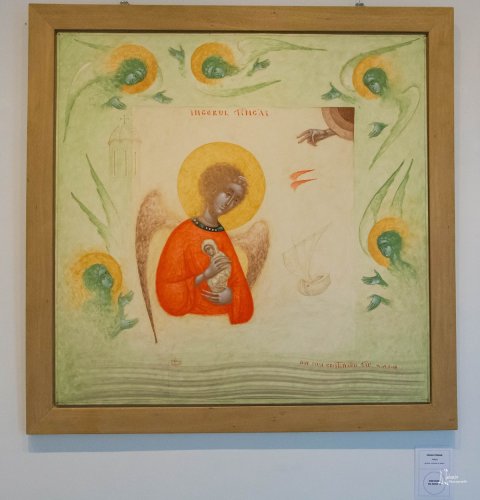
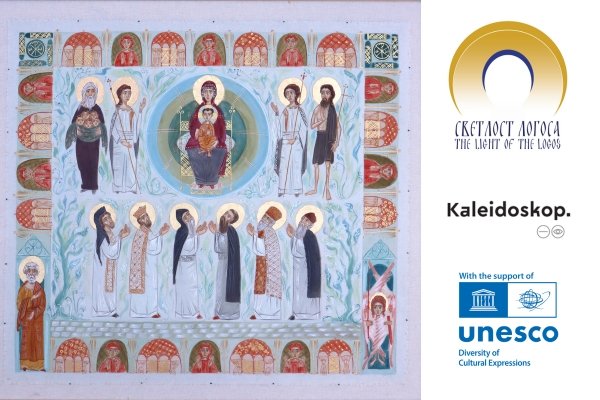
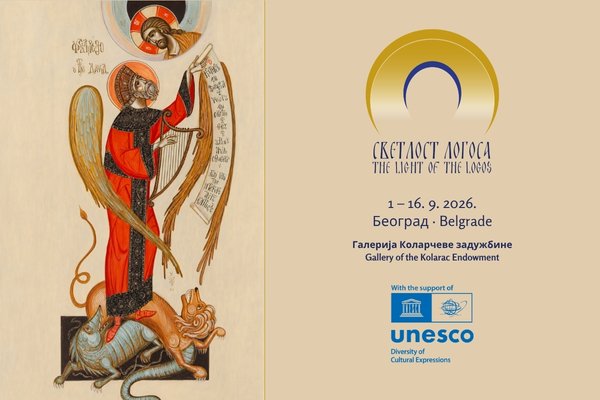
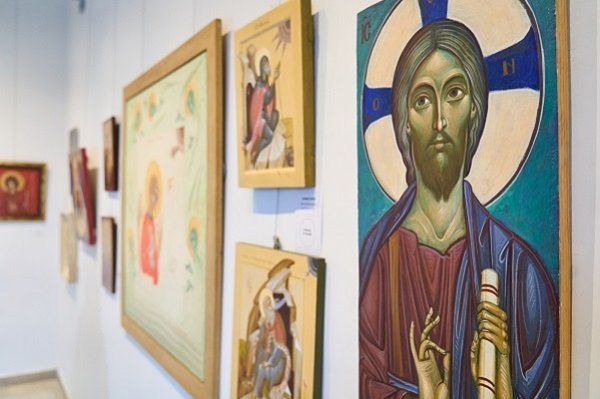
Icon "Angel," 100x100 cm, exhibited by Mihai Coman in 2025 in Belgrade at the "The Light of the Logos" exhibition
Can we nevertheless speak of differences among various Orthodox countries when it comes to styles of icon painting?
Throughout the history of icon painting, many styles have been recorded over the centuries. There are two perspectives.
One is that icon painting as a whole developed from a basic form derived from ancient Greek art, but it evolved into a highly functional language, into a liturgical form of art. This means that it has a structure that conveys content, dogmatic content, in fact historical reality, because we are speaking about the depiction of historical events, of historical presence, of hypostasis.
The saints were hypostatic presences, unique existences in history. We depict this, and this truth cannot be changed by centuries or by geography. If we alter the portrait of Christ, then we propose something false, as happened during the Renaissance. Artists used their contemporaries as models for different saints, and this led to a problematic situation, because we could no longer relate to Christ through another kind of portrait.
The second perspective is that, alongside truth, historical reality, and the structure of the image, there is style as a distinct part of artistic language. So we have content and style, the way we place words into a sentence. Style is very personal. It has changed throughout the centuries and even among painters of the same school, because each person must participate very vividly in the act of painting, just as one does in the Eucharist.
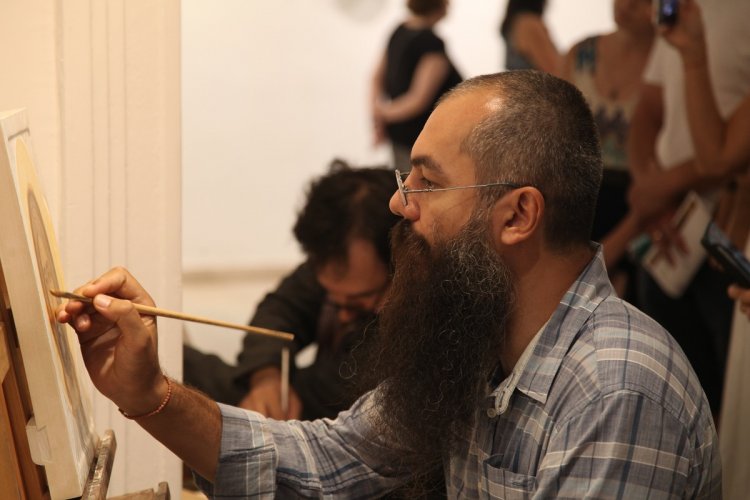
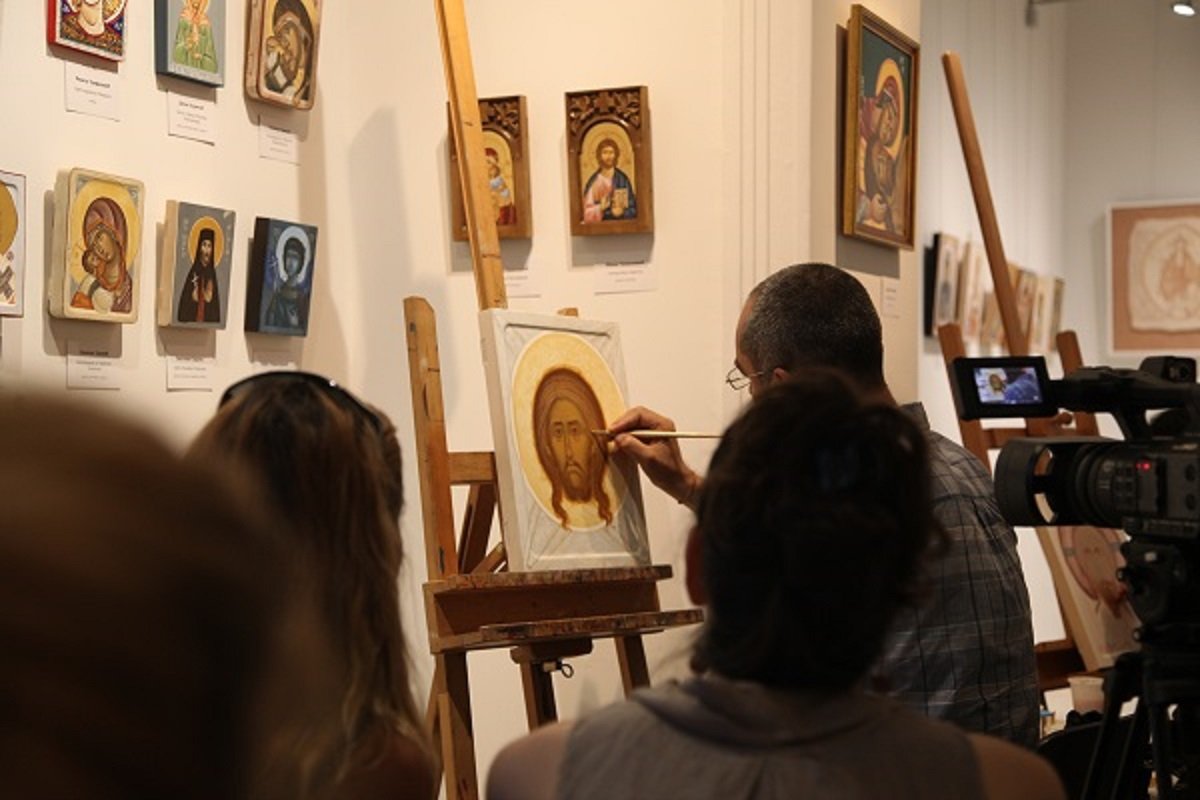
Mihai Coman in Belgrade, painting masterclass at the Kolarac Endowment Gallery, 2024
In what sense?
In the Eucharist, we are personally present. Our presence is defined by our personhood. Our faith is deeply personal. It is not like the army, where everyone does things in the same way. Of course, there is ceremony and we must respect others, but we are present in a very personal and intimate way.
Why? Because the reality of the Church is a relationship: between its members and the community, between each member and God and the saints. A relationship cannot be impersonal. Love can only be deeply personal. You must be who you are, otherwise it does not work. The same is true in the Church, in relationships between people or between human beings and God.
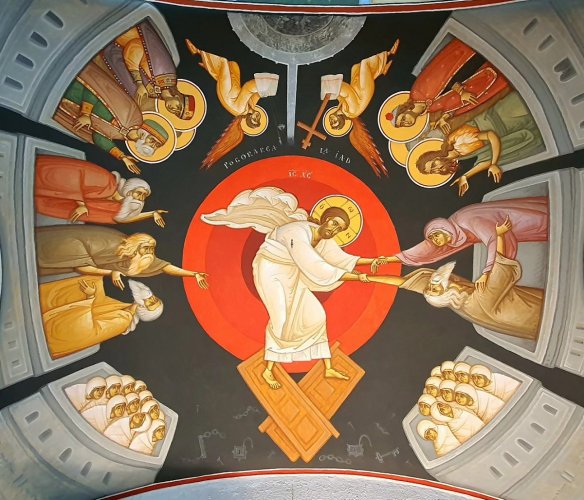
Photo credit: Mihai Coman
Does this also apply to icon painting?
Yes, it is the same with icon painting. We cannot change the dogma of the Church or the historical aspects of events that took place 2,000 years ago, but we must be very personal in the way we express them, in the way we depict them.
I can never speak like Saint John Chrysostom, but I can quote him. If I want to explain how I understand him, I will use my own words, presenting my own experience in relation to that text, that liturgical reality, or that icon. I must be personal. I cannot copy someone when it comes to love.
The icon has two very important components: content and language. The language can change, just as we translate the Bible into different languages. That does not change the truth contained in the text. But the way it is written, or the typeface, concerns style. And that is not a problem as long as it remains readable.
It is wise to choose a style that, in some way, corresponds to the reality it expresses, that is harmonious with it. It is like clothing: we choose it according to the occasion we are attending. Style defines our personality. It is like handwriting; each of us writes differently. Today, content is more important than calligraphy. Style matters insofar as it can help convey content, but it can also block it.
If you use complicated philosophical rhetoric, you can easily lose the attention of less educated people, even if the content you wish to convey is important and meaningful. If you do not use the right language to help the content reach them, you have a problem.
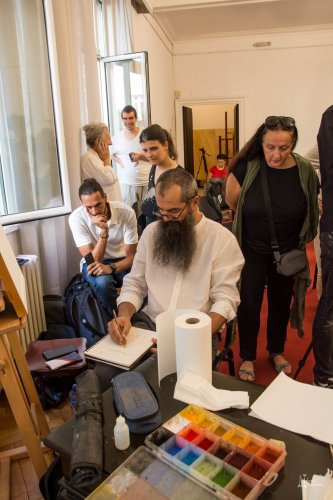
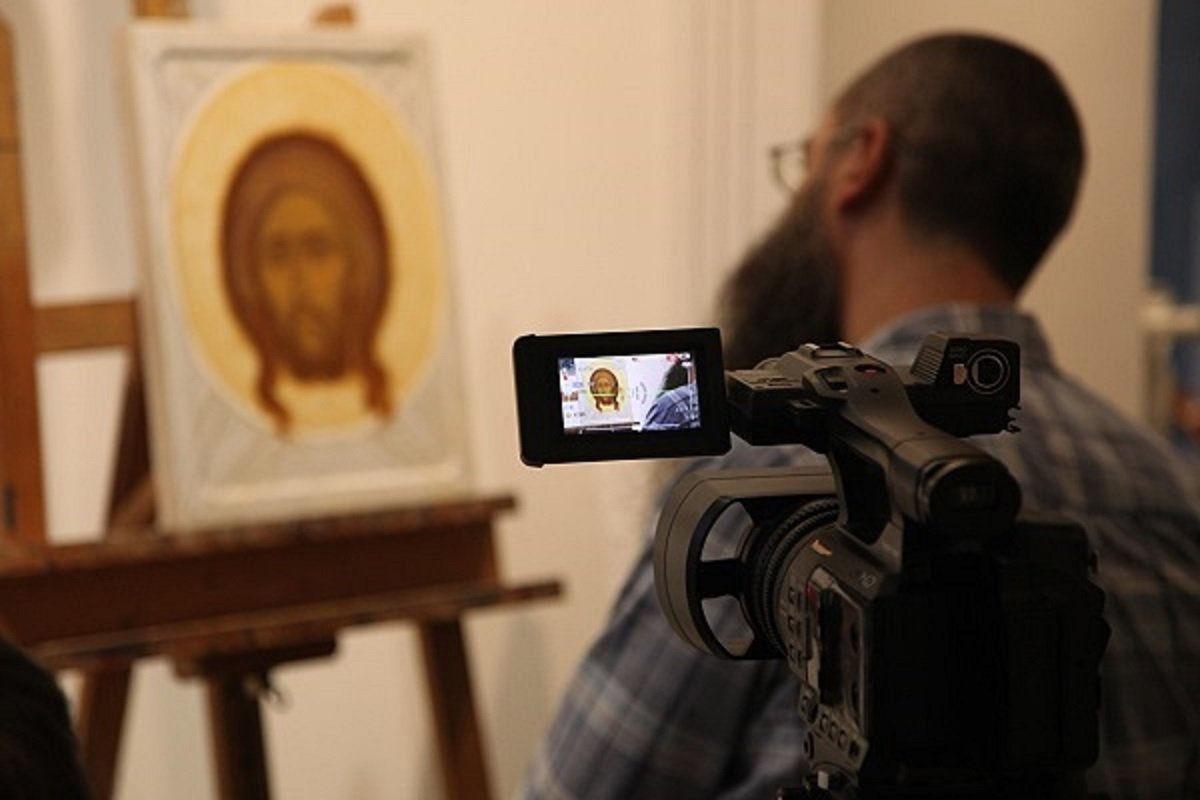
Mihai Coman in Belgrade, 2025 painting masterclass at the The Light of the Logos exhibition
So is the goal simplification?
Why use a highly sophisticated compositional scheme for the viewer to understand the truth being depicted? To bear witness to the represented truth and presence, one can also use very simple methods.
The language of icon painting, as it developed through the Middle Ages and later, was based on clarity and simplicity. This artistic language managed to resist most influences from Western art, not because icon painters were incapable of achieving perspective, chiaroscuro, or other artistic accomplishments, but because these were too complicated and risked redirecting the image and making it more difficult for the viewer.
My professor, to whom I owe a great deal, Giorgos Kordis, always impressed me with his ability to adapt his speech to the person he was addressing. His goal was always to transmit content as easily and directly as possible.
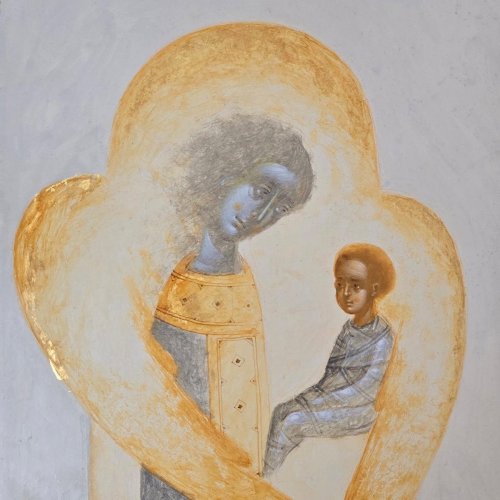
Photo credit: Mihai Coman
How long did you study with Kordis?
I first met the professor in Athens while I was still in high school. I went to meet several other Greek icon painters as well. When I arrived at his studio, he welcomed me with great warmth, and since then I have felt deeply connected to him.
I was not his apprentice in the traditional sense. I would occasionally go to Athens, gradually get to know him, and spend shorter periods of time with him. Later, in 2008, I wrote my doctoral thesis under his supervision. We never painted together, but for three years I attended his classes at the Faculty of Theology and his private icon painting school.
The most important thing I took from that relationship was the understanding that the artistic language of the icon is deeply and realistically connected to the reality it depicts. It is not a symbolic language, but a functional one. The plastic and painterly elements are arranged in a particular way, regardless of style, so that the icon functions much like liturgical light is necessary for life.
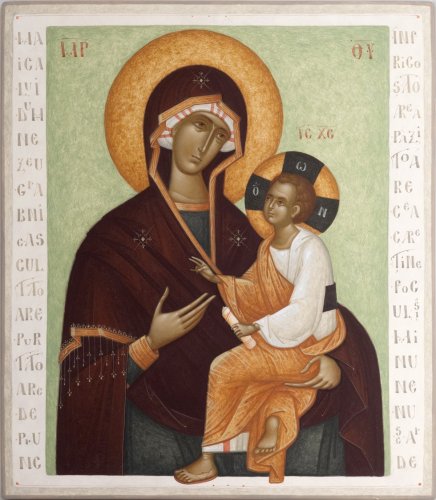
Mihai Coman, The Mother of God “Helper Quickly”, 35x40 cm
Your style is very recognizable. Many of your works are dominated by yellow and ochre tones. Is that a conscious decision?
No. I am a joyful person, and that is why I love colors. I believe there is nothing unusual, unclassical, or new in my palette. My choice is pure colors.
Icons generally function through clear, pure forms and colors. They allow the viewer to understand and “read” the icon more easily. Forms must also be clear. All of this brings a sense of peace. The viewer does not struggle to understand.
Do colors have symbolic meaning in Orthodox iconography?
No, they do not have symbolic meaning. I have a very simple argument for that. In churches, there is a very limited number of basic colors. The same red, for example, is used for the Mother of God, for Christ, and for Saint George. It is the only red we have.
What matters is achieving unity, a color that travels throughout the entire painted wall ensemble and gives dynamism and rhythm to the compositions.
As for the yellow I use, it is warm, a color of light, very present in our tradition. In Orthodox churches, candles are yellow, not white as in Western Christianity. White is the color of purity. We are not seeking purity. The color of our candles speaks of sacrifice, of the sacrifice of the bee that produces honey and wax, and of our own bloodless sacrifice offered at the altar.
This report is part of the project Serbian Culture in the Focus of UNESCO, through which the Kaleidoskop Cultural Center marks the 850th anniversary of the birth of Saint Sava and, at UNESCO’s invitation, joins the global celebration of the 20th anniversary of the Convention on Cultural Diversity.
The project is co-funded by the Ministry of Information and Telecommunications. The views expressed in this supported media project do not necessarily reflect those of the institution that provided the funding.
READ ALSO:
PALACE OF SERBIA: PRIMER OF CONTEMPORARY ART
ICON: FROM CRAFT TO CONTEMPORARY ART
RETROSPECTIVE: THE LIGHT OF THE LOGOS 2025
All content on the Kaleidoskop media magazine portal is free of charge, and the website is financed exclusively through donations from readers and friends.
Support the work of our magazine HERE










Komentari