

By Miona Kovačević / Photos by Andjelija and Todor Lepčević
As part of the project “Serbian Culture in the Focus of UNESCO,” which explores through contemporary sacred art the ways in which cultural heritage is not only preserved but actively developed, we spoke with Todor Lepčević, an artistic gilder whose work pushes the boundaries of classical icon painting.
His icons, executed in full gilding, draw upon deep layers of Byzantine heritage while simultaneously opening space for an authorial approach, transforming gilding from a mere ornament into an independent language of icon painting.

Todor’s unusual path—from a grammar school student and graduate of a basic music school, through studies in general literature and organic agriculture, to becoming an icon painter and a current student at the Faculty of Orthodox Theology—has shaped an artist of broad life experience and academic knowledge.
By developing a unique, authorial gilding technique inspired by Byzantine icons, he revives nearly forgotten layers of sacred art and translates them into a contemporary context.

Todor Lepčević
In his interview for Kaleidoscope Media, Lepčević speaks about “iconographic succession,” light as both a theological and visual principle, the importance of handmade work in an age of digital images, and the responsibility of the artist toward tradition—not as something to be frozen, but as something to be continued.
Tell us about your beginnings in icon painting. How did you move from studying literature and organic agriculture to painting icons?
The paths of seeking God are indeed mysterious. I feel a strong affinity with the Renaissance idea of homo universalis—a person who strives, through all skills, all forms of humanistic activity, and knowledge in general, to reach a sense of wholeness. Of course, I do not believe it is possible to be complete in knowledge across all fields, as each discipline today is developed in such depth that it takes an entire lifetime to become a professional in just one. However, as a believer, I see guidance toward God in everything. As one of my literature professors used to say, “The first and fundamental question in life should be: ‘Is there God or is there not?’—and only then everything else.”
Science (agriculture) is not separate from religion, nor is religion, as some believe, a private matter—a self-contained language understood only by believers. Everything is connected by invisible threads. It is no coincidence, therefore, that Goethe engaged with both science and religion, while being one of the greatest writers.
This is how I see life with my family as well. An ideal landscape (locus amoenus) for us would be living in the countryside, engaging in art, and at the same time applying scientific knowledge—agriculture—to rural life: living off the fruits of the land, creating fruitfully as artists, and above all being active believers, so that our deeds may be known by their fruits. Farming is deeply connected to faith, just as iconography is inseparable from the life of the Church.
Many artists I know have arrived at similar convictions. Artists, in general, strive for a calm and peaceful life, because only in such conditions is it possible to create with joy. Some Russian artists I follow retreat to forest cabins, disappear for half a year, create, live like hermits, and then return among people with their works. I deeply respect this, because they are, above all, honest with themselves: they know what brings them joy and they pursue it. They are unaffected by stereotypes and judgments; instead, they go off and create in some wilderness, like hermits. For creative work—and especially for iconography—it is essential to work on oneself.
Today, icons in full gold have become your artistic signature. How did that come about? Was there a particular inspiration or motivation?
Certainly. There were earlier attempts, albeit fragmentary, to create works of art using gilding alone. I enjoy experimenting with the possibilities of gilding. I have produced several works entirely using gilding techniques. My intention was to demonstrate all the possibilities of gilding that are often overlooked.
Gilding is a highly complex craft. My colleagues—serious gilders—know that dedicating one’s entire life solely to gilding can still be challenging. I regret hearing people say that gilding is merely a decorative accompaniment to an icon and that it is not necessary to engage deeply with it. I believe that gilding, in the context of “artistic gilding,” is a demanding and difficult craft and not an entry-level step in icon painting. I strive to show that gilding goes beyond craftsmanship—that it is also a form of artistic expression. Naturally, it has its limitations, just like mosaic or wood carving. One cannot achieve the same range of expression as in painting. Yet it is possible to use all the charms of gilding and, with what is available, create a work of art. Gilding therefore has its own language—one that painting alone does not possess.

Victorious Cherub, by Todor Lepčević
Can we say that an icon in full gilding represents a new form of icon painting? Has anyone worked in this way before you?
Conditionally speaking, one could say that. I would certainly like gilding to be viewed in this way, but much depends on me—on how much I create—as well as on others who may follow this path. We should not forget that throughout art history there have been many attempts, and something only truly takes root once it is recognized or widely applied. Even great gilders, whose work I closely follow, would hesitate to claim that gilding could be a new form of icon painting.
Before me, I encountered works by Russian artists. There were certainly attempts to convey entire iconographic content through the language of gilding, but these did not take hold.
I find my grounding in the tradition of Byzantine iconography. The workshops I looked up to did not use the same gilding techniques, but they did employ gilding. These were relief icons from the 10th to the 12th century, produced in the workshops of Constantinople. The icon that most influenced my work, now kept in St. Mark’s Basilica in Venice, is the icon of the Holy Archangel Michael. It was technologically very complex and extremely expensive to produce. These are likely the reasons why this branch of art did not flourish. Everything that is complex and costly to create struggles to survive, yet across centuries it bears witness through its beauty. The icon was made using silver-gilt techniques and cloisonné enamel for the figures of the saints, and it is adorned with precious stones.
While gazing at the magnificent icon of the Archangel Michael, created in my beloved ancient Byzantium, I felt the desire to achieve a similar effect through gilding techniques—to revive, in some way, a bygone branch of art in a new manner, while simultaneously expanding the possibilities of gilding. Whether I have succeeded, I would prefer others to judge.

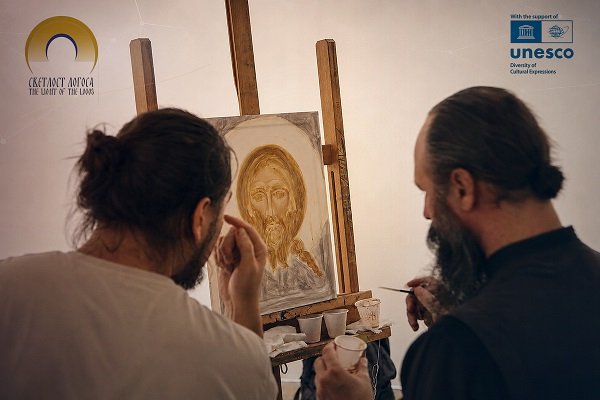
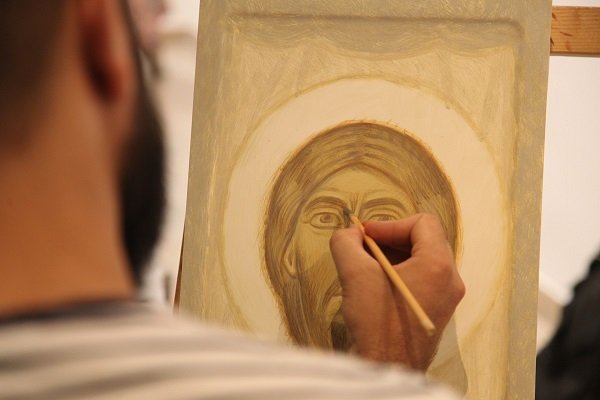
The demanding process of creating a full-gold icon, Todor Lepčević in the studio
Could you briefly explain the process of making such works?
With pleasure. Gilding can be roughly divided into gilding on water-permeable surfaces and on non-permeable surfaces. What is most important—and often overlooked—is that the surface must be of very high quality. This means that the preparation layer must be flawless: without scratches, stains, holes, or unevenness, and wiped with alcohol before use. This is crucial, as any mistake can have fatal consequences for the final outcome. Sometimes imperfections are not immediately visible, so it is best to turn the panel toward the light, allowing every scratch to cast a shadow at an angle. Correcting such imperfections can take days.
Once the surface is properly prepared, we decide which gilding technique to use. I generally employ two main techniques: oil gilding on shellac and water gilding on bole. After that, I apply the gold ground, sand it, and then gild it.

The Geometry of the Throne
How long does it take to create a gilded icon?
It depends on the complexity of the work. What is particularly challenging is combined gilding (using more than one gold leaf), creating pastiglia relief, and freehand engraving on gold with an agate tool. One small mistake and everything must be redone. For simpler gilded works, about two weeks are needed. More complex pieces can take several months. I am currently working on two icons for an upcoming exhibition, co-authored by myself and my wife, Anđelija. I have been working on them for a long time, and I expect to continue gilding for at least another month and a half.
Simply put, it is impossible to speed up the process if quality is the goal. Gilding often takes much longer than painting itself. Considering some of the most complex works I have done, I am not sure there is another art form comparable to artistic gilding in terms of production time.

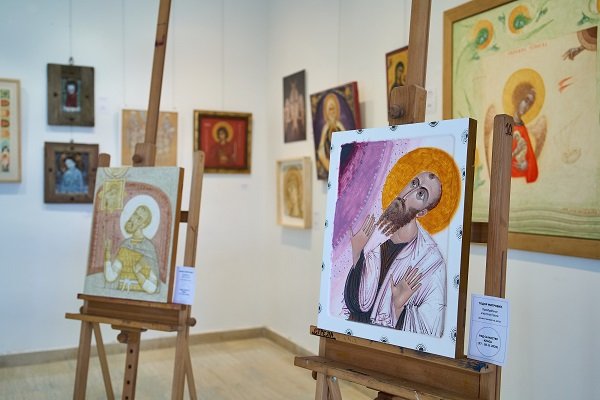
Saint Sava in Heavenly Vestments, joint work by Andjelija and Todor Lepčević
Gold is a material of exceptional symbolic and physical power. How do you balance its tangible, material nature with its spiritual, almost immaterial symbolism in Christian art?
Gold has always pointed to the light of the age to come. It adorned Gospels, draperies, walls, frescoes, and icons. On icons, gold makes the background glow, allowing light to settle in the viewer’s eye as it reflects off the surface. This is something painting alone does not possess—the play of light and shadow on another plane. Gilding reflects light and therefore always depends on its source. In daylight, gilding shines with the strength of the sky and the sun; in evening light, from candles or lamps, it glows more softly. This means that the light of gilding depends on many conditions and is never the same. Gilding follows the rhythm of light and, like a chameleon, changes and adapts to the light of the space in which it is placed. Perhaps the most beautiful aspect of gilding is that the resulting work is always different—it depends on the viewing angle, the intensity of light, the time of day, and so on.
Although this is the material aspect of gilding, it is inseparably connected to its immaterial symbolism—to the Taboric light, the light we are still unable to fully comprehend.
I carry a nostalgic feeling from my childhood. I remember one seemingly insignificant moment that is deeply embedded in me. I was sitting in a meadow by the Danube. A warm breeze embraced me as I inhaled deeply the scent of grass and river mud, while poplar fluff drifted through the air. Frogs croaked in chorus with crickets as I looked at the trees and the clear sky with a few clouds. I vividly remember the sense of beauty I experienced—at that moment, I was truly illuminated by the beauty of God’s creation. I often return to that feeling, imagining what the beauty of the age to come must be like. When I look at a finished gilded work, I experience a similar sense of psychagogical beauty.

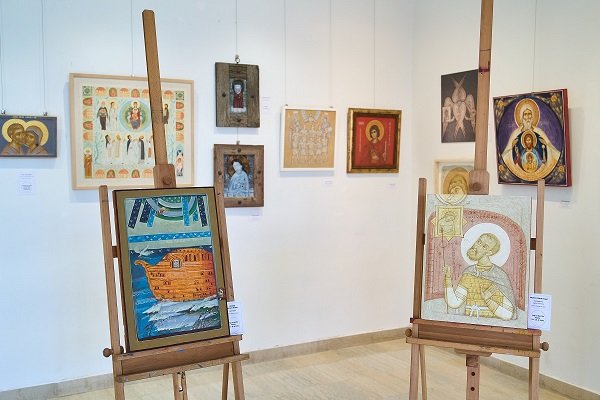
Saint Theodore the Studite, a joint work by Andjelija and Todor Lepčević
Alongside your artistic work, you are also studying at the Faculty of Theology. How does theological education influence your artistic process and the way you “read” an icon while creating it?
An icon can be approached both theologically and from the perspective of art history. Ideally, it should be considered through both lenses. It is preferable to first examine the theological aspect, as the icon is truly a reflection of the life of the Church.
Knowledge of the history of theology is immensely valuable for icon painters. At the Faculty of Theology, one acquires academic knowledge across all branches of theological history. Liturgics is particularly important, as icon painting is most closely connected to liturgy. For example, the development of certain feasts—Christmas, Epiphany, the Presentation—often coincides with the development of their iconographic scenes. Thus, by following the development of a feast, we also follow the development of the icon intimately linked to it. Knowledge of the Holy Scripture is equally fruitful for artistic creation, as Scripture is our primary source of knowledge. Patrology—the teachings of the Church Fathers—is especially significant for icons of saints, as it acquaints the icon painter with their lives, thereby enriching the creative process. Learning ancient languages—Ancient Greek and Church Slavonic—is essential for writing inscriptions on icons.
For all these reasons, I see theological education as extremely important for our artistic work. What we learn becomes embedded in our knowledge, almost becoming part of our personality. In moments of inspiration, I often recall verses from Scripture, from which ideas for icons then develop. This is why it is important, even today, to keep knowledge in one’s mind rather than on paper—what we truly learn lives with us and within us. Here I would recall the words of His Holiness: that all knowledge must be grounded in deeds and not acquired for its own sake alone.

The Golden Seraphim
How would you describe your personal dialogue with tradition—where does it end, and where do experiment and contemporary expression begin?
Tradition is everything connected to an unbroken past. Paradosis—tradition—means “that which is handed down,” like a relay baton. We have inherited something that we must carry forward. This does not imply rejecting the old, because rejection erases what we have inherited; rather, what is inherited always leaves room for development and renewal.
Almost every great artist of the past left a personal mark on tradition—and icon painters were no exception. The earliest icons of the Crucifixion depict Christ fully clothed in dark draperies, sometimes even with open eyes—very different from later canonical representations. The same applies to many other scenes, such as the Entry into Jerusalem, the Descent into Hades, the Last Supper, or the Nativity. What unites all narrative icons, however, is the theological justification of innovation. Every change throughout history was meaningfully grounded and connected to the life of the Church community.
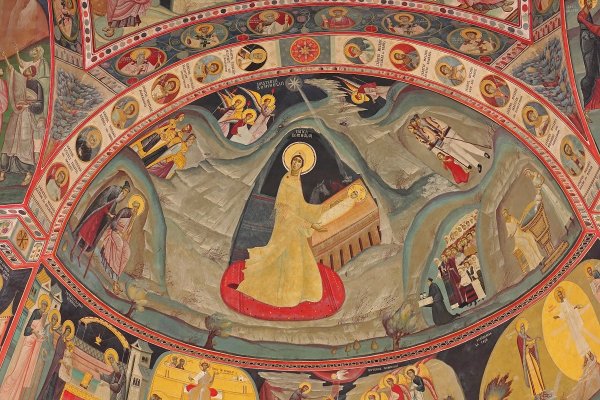
For instance, Christ begins to be depicted later in red and blue garments, whereas earlier depictions often showed Him in black, white, or gold drapery. This change was important due to the Church’s teaching on the human and divine natures, will, and energy in Christ—issues clarified through the history of dogmatics in response to monophysite teachings. The same applies to depictions of the Mother of God and the three stars on her garments, which were emphasized during periods when her virginity was questioned. We also have the famous depiction of the Virgin Orans—a prayer posture with raised hands, once common in antiquity and preserved today primarily through iconography.
All these examples testify to the logic of the development of icon painting and to how icons are conditioned by the life of the Church. Innovation, therefore, is permissible within these boundaries, but not beyond them.

Our Lord Jesus Christ
What do you mean by that in concrete terms?
If personal experience is introduced into an icon without being tested against Church teaching, it does not contribute to the continuation of tradition. Personal expression is possible precisely within the abundance of tradition and through its use for new representations. Sometimes certain scenes have been scarcely depicted, or there are few representations of a particular saint—this opens space for artistic interpretation. One notable example is Professor Dr. Todor Mitrović’s Exodus from Egypt, an excellent artistic solution realized in the artist’s own style.
For instance, on our icon of Saint Ignatius the God-bearer, The Inverted Colosseum, we directed the lions toward the audience rather than the saint. This small, almost imperceptible change is theologically justified, as it represents an eschatological rather than a historical scene. An eschatological depiction calls for a triumphant image of victory, not one of historical suffering.

Saint Ignatius the God-bearer, “The Inverted Colosseum”
What do you consider the most important legacy a contemporary artist can leave—faithful preservation of form or the courage to further develop it?
I firmly advocate for the natural development of icon painting—that is, for courageous development. At the same time, I believe that both those who faithfully preserve traditional forms and those who contribute to the evolution of iconographic art are, in their own way, right.
My wife and I practice both approaches. Many icons are executed entirely in accordance with tradition, but when creating for exhibitions or special occasions, we strive to do what icon painters of all eras have done—to create a unique work of art. This is not easy, as innovation requires a great deal of time dedicated to composition, but the feeling of completing such a work is profoundly rewarding. That is why we cherish opportunities to participate in the creation of new icons—it is the most beautiful part of the creative process.
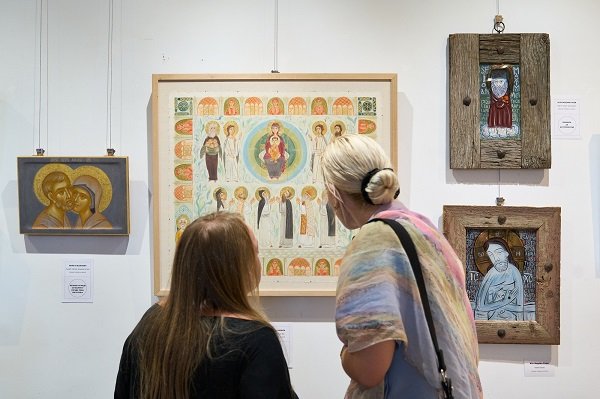
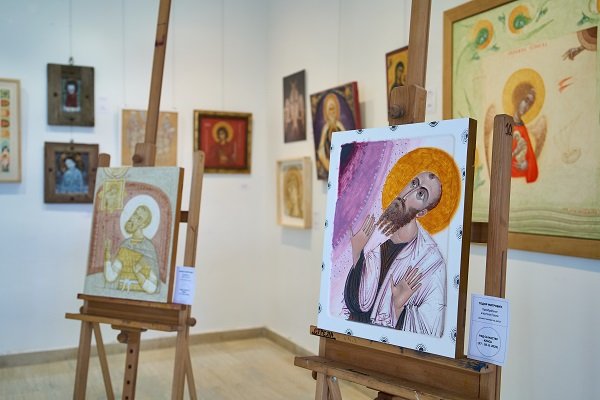
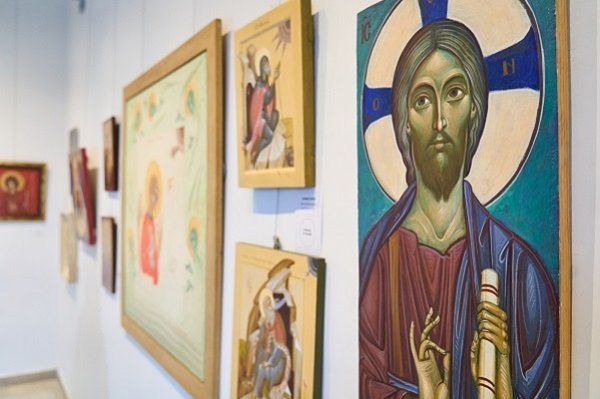
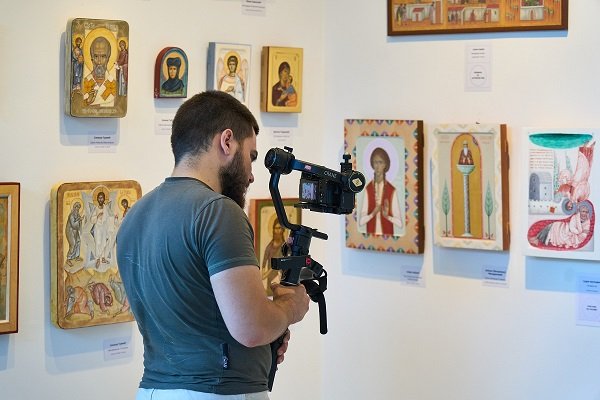
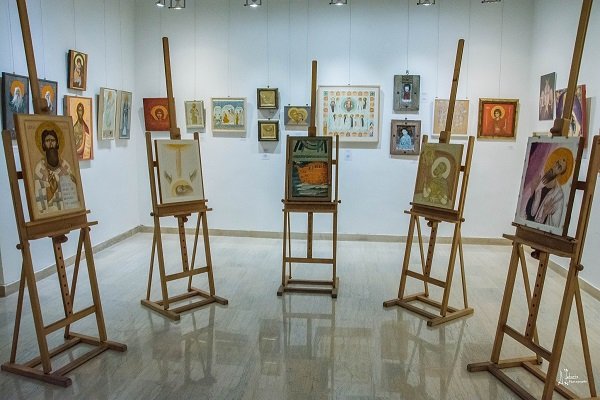
Exhibitions dedicated to Christian sacred art play a crucial role here. They are a kind of jewel, bringing together young artists and giving us the opportunity to present our works—icons of contemporary expression—to the faithful.

Andjelija and Todor Dimitrijević, Saint Peter with the Golden Rooster
How would you assess the current scene of contemporary sacred art in Serbia and the region?
I truly believe there is a great blessing upon our people when it comes to icon painting. We have so many artists from different disciplines contributing to contemporary sacred art, and the number of young artists is growing. This is encouraging, as it shows both the willingness of young artists to contribute to Church art and the response of believers who wish to commission their works.
What is most beautiful is that all this creativity is blessed by the Church and that exhibitions are open to everyone. Who knows—perhaps someone may even find a path to faith through admiration of a work of art?
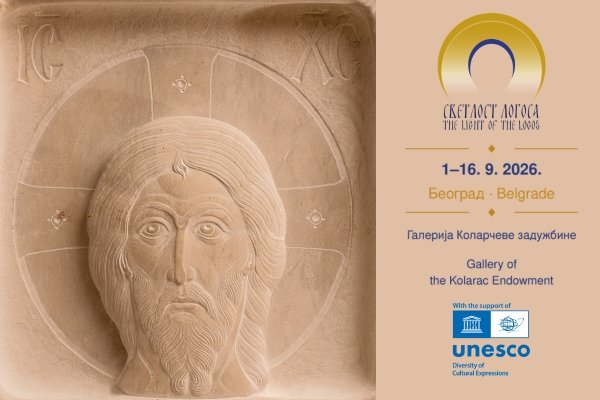
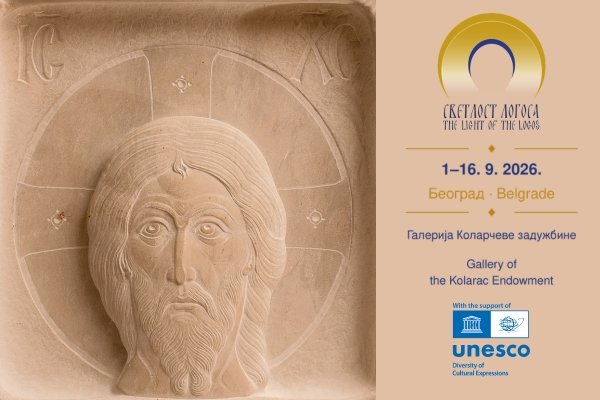
In this regard, I would like to express special gratitude to the organizers of the international exhibition The Light of the Logos for the scope of their contribution to the field of iconography, as well as for their openness toward young artists.
Any form of support is welcome, and ultimately such support reflects positively on Serbian cultural heritage. Everything created today will become part of the past in a hundred years’ time—this is how the tradition of icon painting best endures.

Two icons by Todor Lepčević from Light of the Logos 2025: Golden Lion (St. Mark) and Golden Eagle (St. John), in gold
Where do you see the place of artistic gilding and slow, handmade work in today’s age of fast images and digital media?
Just as the Church speaks of “apostolic succession,” passed down through teaching, we might also speak of “iconographic succession” in art. Knowledge, craftsmanship, and styles are transmitted from generation to generation, from the earliest centuries to today.
What is essential for every form of creation is time. Art cannot be accelerated or simplified. As human beings, no matter how skilled we are, we cannot compete with artificial intelligence, machines, or mass-produced objects that are not handmade. Equating handcrafted works with non-handcrafted ones risks devaluing our time and effort. Iconographic succession always implies living painting. The personality of the artist, their life, artistically shapes Life—Christ Himself. This requires time, sacrifice, effort, and skill. There are no shortcuts or hidden paths to true craftsmanship—only experience, time, knowledge, and dedication.
I sometimes see “icons” created by artificial intelligence in a matter of seconds, easily mass-printed in thousands of copies. Our artistic works take weeks to create. If someone cannot afford a professional icon painter’s work, they can always commission students or beginners who are learning and improving, at a more accessible price. There is always an alternative. It is better to have a living icon in one’s home—to invest in a handmade work that is passed down through generations. A true family patron-saint icon, the greatest value in any household, should also be among the most cherished possessions in one’s home.
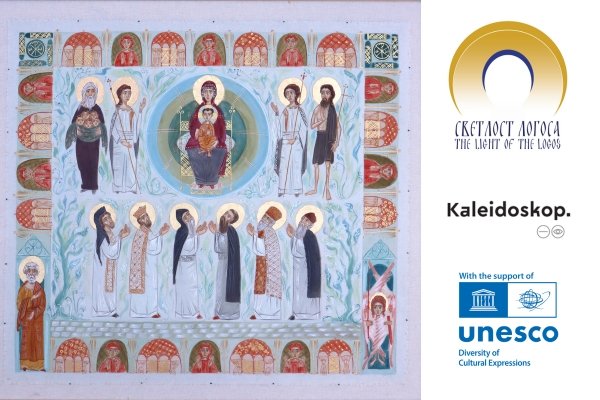
This report is part of the project Serbian Culture in the Focus of UNESCO, through which the Kaleidoskop Cultural Center marks the 850th anniversary of the birth of Saint Sava and, at UNESCO’s invitation, joins the global celebration of the 20th anniversary of the Convention on Cultural Diversity.
The project is co-funded by the Ministry of Information and Telecommunications. The views expressed in this supported media project do not necessarily reflect those of the institution that provided the funding.
READ ALSO:
PALACE OF SERBIA: PRIMER OF CONTEMPORARY ART
RETROSPECTIVE: THE LIGHT OF THE LOGOS 2025
All content on the Kaleidoskop media magazine portal is free of charge, and the website is financed exclusively through donations from readers and friends.
Support the work of our magazine HERE










Komentari